BackTLC NAND

TLC NAND

SK hynix
2026-08-24 14:13:39

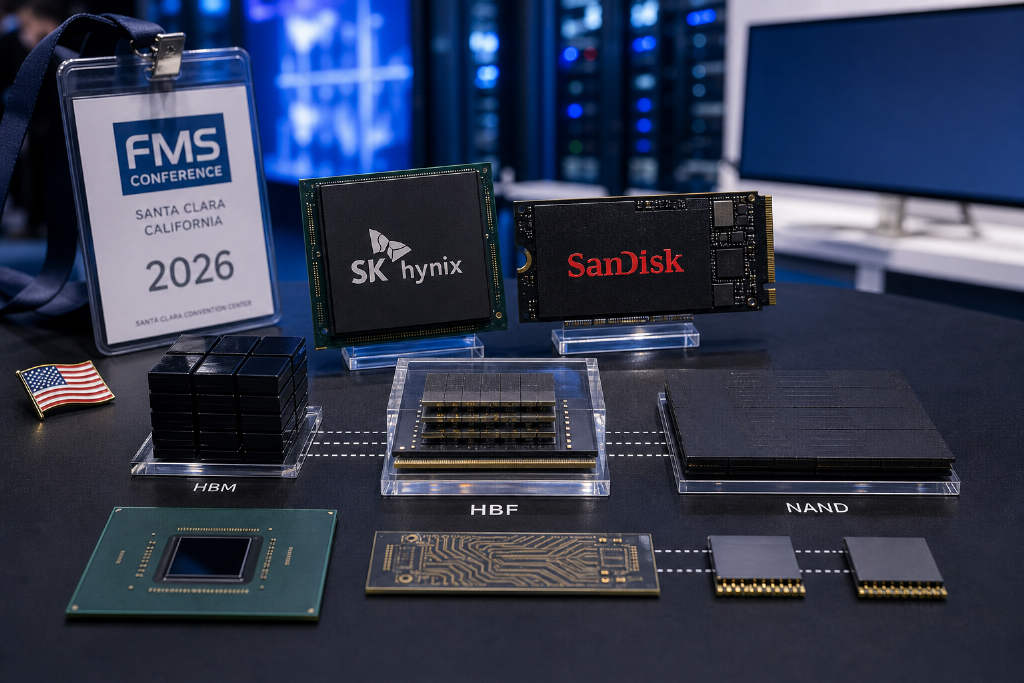
SK hynix and SanDisk unveil the first HBF standard at FMS 2026

SK hynix and SanDisk introduced the first HBF specification at the 2026 FMS Conference in Santa Clara, California. The first version targets up to 512GB of capacity and bandwidth ranging from 0.4 TB/s to 3.0 TB/s, with UCIe used as the interconnect between HBF and the processor. SanDisk also showed a test case suggesting that, in a specific AI inference setup, four GPUs paired with 4TB of HBF delivered nearly the same token output per second as eight GPUs paired with 192GB of HBM. The companies are positioning HBF as a new memory tier between HBM and conventional NAND storage. SK hynix also outlined a revised memory hierarchy that adds G0.5, G1.5 and G2.5 tiers, while SanDisk said HBF is meant to support persistent KV cache and other large inference-state data. The roadmap now points to a full HBF specification in early 2027 and samples in early 2028.
560
SK hynix and SanDisk unveil the first HBF standard at FMS 2026
AI Inference
2026-08-15 07:30:00

AI inference is pushing NAND deeper into the memory stack, and Sandisk is betting on it

AI spending in semiconductors has largely been framed around GPUs, high-bandwidth memory, networking and power. This report argues that inference is widening that trade. As AI systems move from training to serving billions of queries, enterprise agents, multimodal workloads and real-time applications, the need to keep large pools of data accessible at reasonable cost is becoming more central. That is giving NAND a larger role as a capacity layer alongside HBM and DRAM, rather than leaving it as a conventional commodity storage product. Sandisk has become one of the clearest public advocates of that view. At its 2026 investor day, the company said enterprise data center flash demand could reach 1.2 ZB by 2030 and projected mid-to-high double-digit annual revenue growth from FY2028 through FY2030, with Reuters cited in the source for related expectations. The company is also developing High Bandwidth Flash, or HBF, for AI inference, while continuing to push denser QLC NAND products. At the same time, Sandisk and other storage makers are leaning more heavily on multi-year customer agreements. Reuters, as cited in the source, reported that Sandisk had signed eight long-term agreements with six customers worth about $93.9 billion in total. The article’s main conclusion is narrower than a permanent re-rating story. AI is unlikely to erase NAND cyclicality. What may change is the amplitude: stronger bit demand, better demand visibility and tighter supply discipline could make future NAND cycles less violent than in the past.

850
AI inference is pushing NAND deeper into the memory stack, and Sandisk is betting on it
Kioxia
2026-08-05 00:09:52

Kioxia and Sandisk unveil 332-layer QLC 3D NAND with 4,800 MT/s interface

Kioxia and Sandisk introduced their latest BiCS10 3D QLC NAND flash chip at the Future of Memory and Storage Conference on Aug. 5, describing it as the highest-density 3D NAND product that has been formally launched worldwide. The chip uses a 332-layer stack and reaches a storage density of 37 Gb/mm², with interface speeds of up to 4,800 MT/s and support for Separate Command Address, or SCA. The companies said the product is aimed at high-capacity data center SSDs. Compared with their earlier BiCS10 3D TLC NAND, which delivered storage density above 29 Gb/mm², the new QLC version pushes capacity density higher for data center storage. Industry estimates cited in the report said the chip could reach roughly 1.33 Tb under similar die size and memory cell count assumptions, though the companies have not disclosed an official capacity specification. Kioxia and Sandisk also introduced PI-LTT technology to improve high-speed signal integrity while reducing output driver power consumption. The two companies said the latest BiCS10 process could also help lower manufacturing costs after production ramps up.

1360
Kioxia and Sandisk unveil 332-layer QLC 3D NAND with 4,800 MT/s interface
Memory Chips
2026-06-25 19:01:00

Memory Chip Giants Hit Record Highs but Trade at Single-Digit PEs: How AI Turns Storage from Commodity to Luxury

Micron's latest earnings for FY2026 Q3 reported revenue of $41.46 billion, beating estimates by nearly $6 billion, with gross margin guidance of 86%. The stock surged 13–14% after hours, pushing market cap above $1.16 trillion. Despite year-to-date gains of over 300%, the forward P/E of the top three memory makers (Micron, SK Hynix, Samsung) sits at just 6–10x, compared to NVIDIA's 23x and the semiconductor median of 36x. Analysts argue that HBM demand has broken the long-standing DRAM cost decline curve, transforming memory from a commodity into a luxury good. The upcoming earnings season includes TSMC, Samsung, SK Hynix, and Western Digital. Importantly, NAND supply is even tighter than HBM, with Western Digital and SanDisk being the best-performing S&P 500 stocks in 2026, signaling NAND could be the next major theme.

360
Memory Chip Giants Hit Record Highs but Trade at Single-Digit PEs: How AI Turns Storage from Commodity to Luxury